Sleep Apnea: A Sleep Disorder That Can Increase Heart Attack Risk
Have you ever woken up tired in the morning, even though you've slept all night? Or perhaps your partner has complained about your loud snoring every night? If so, you may be suffering from sleep apnea, a sleep disorder that's more dangerous than just a nuisance.
Sleep apnea is often considered a minor problem, but its impact on health can be very serious, even tripling the risk of heart attack. According to data from the American Heart Association, sleep apnea directly contributes to heart rhythm disturbances, hypertension, and decreased blood oxygen levels.
In Indonesia, coronary heart disease and cardiovascular disease are the leading causes of death. According to data from World Heart Federation in 2021, there were approximately 765,660 deaths due to cardiovascular disease in Indonesia.
To understand further, let's start from the basics, why seemingly simple sleep apnea can actually trigger serious conditions such as heart attacks.
What sleep apnea is and how it affects the heart
Signs you may be experiencing it
Long-term health impacts
How heart attack insurance can help reduce financial stress if the unexpected happens
Before continuing, you may be interested in reading the following relevant articles:
Now, let's understand how sleep disorders like OSA can develop into serious risks for your heart.
Why Your Sleep Disorder Shouldn't Be Ignored
Imagine if every night you stopped breathing for a few seconds, then suddenly woke up in a hurry or gasping for breath, then the next night it happens again without you realizing it. This condition is typical of Obstructive Sleep Apnea (OSA), a sleep disorder that is often considered trivial.
Sleep apnea is often considered a trivial problem, but its impact on health can be very serious, including increasing the risk of heart attack by up to three times.
Research published in the Journal of the American Heart Association shows that obstructive sleep apnea (OSA) is strongly associated with a higher risk of cardiovascular disease, including heart attack and heart failure. This association remains significant even after adjusting for factors such as age and other health conditions.
According to Journal of Natural Science, Biology and Medicine, The population at risk of OSA in Indonesia is quite large and often undiagnosed, so the potential impact on heart health is also high.
To understand the medical risks, we need to look at how OSA affects the body, especially your cardiovascular system. In the next section we will discuss in more depth how OSA can be a major trigger for heart disease.
How Sleep Apnea Affects Your Heart
When you have obstructive sleep apnea (OSA), your upper airway periodically collapses or narrows. This causes decreased oxygen flow (intermittent hypoxemia) and a surge in sympathetic nervous system activity known as the "fight or flight" response during sleep.According to research published by Journal of the American Heart Association, this condition can trigger a series of physiological responses that put a strain on your heart.
As a result, several serious disorders can occur such as:
Chronic hypertension
Research referenced by the U.S. The National Institutes of Health indicates that OSA can repeatedly raise blood pressure during sleep, which may contribute to long-term (systemic) hypertension.
Arrhythmia and heart failure
Repeated surges in sympathetic (“fight-or-flight”) activity can increase the risk of abnormal heart rhythms and place extra strain on the heart. Over time, untreated OSA may contribute to heart failure in high-risk individuals.
Coronary artery dysfunction
Research from Archives of Medical Science stated that inadequate oxygen during sleep causes oxidative stress and inflammation, which can damage the lining of blood vessels (endothelium) and trigger coronary heart disease.
These clinical findings are also supported by various studies and meta-analyses highlighting the link between OSA and heart attacks.
Empirical Evidence of Heart Attack Risk
Several studies and meta-analyses have shown a number of important facts about the relationship between Obstructive Sleep Apnea (OSA) and heart disease and cardiovascular risk:
A meta-analysis of 12 prospective cohort studies (25,760 participants) found that severe OSA was associated with a 1.79× higher risk of cardiovascular disease (including coronary heart disease and stroke) compared with no OSA.
Meta-analysis Archives of Medical Science confirmed that severe and moderate OSA significantly increases the risk of major cardiovascular events, including myocardial infarction (heart attack), heart failure, and death from heart problems.
The latest research from UT Southwestern Medical Center showed that OSA is associated with an increased risk of cardiovascular disease even in adults under 40 years of age.
These findings demonstrate that OSA is more than just a minor sleep problem or discomfort. Therefore, it's important to recognize the common signs of sleep apnea that often go unnoticed.
Often Ignored Signs
Some indications of OSA that you should be aware of:
Snoring loudly every night, then suddenly stopping breathing or gasping for breath
Waking up with a dry mouth or sore throat
Often feel tired during the day or have difficulty focusing
High blood pressure that is difficult to control
If you have one or more of these signs, and also have risk factors such as obesity, a large neck, or age over 40, you should have an evaluation by a sleep doctor or heart specialist.
Fortunately, sleep apnea can be detected and managed before it develops into a more serious condition. Here are some medically recommended steps.
Medical Detection & Management
When you suspect you have Obstructive Sleep Apnea (OSA), there are several medical and lifestyle steps that have been scientifically proven to help reduce the risk of heart problems due to OSA:
1. Sleep testing as the first step
To diagnose OSA, doctors typically recommend a sleep study, most commonly polysomnography (PSG). PSG can detect apnea/hypopnea events, oxygen drops, and heart rhythm changes during sleep, which helps determine severity and guide treatment.
2. CPAP therapy to keep the airways open
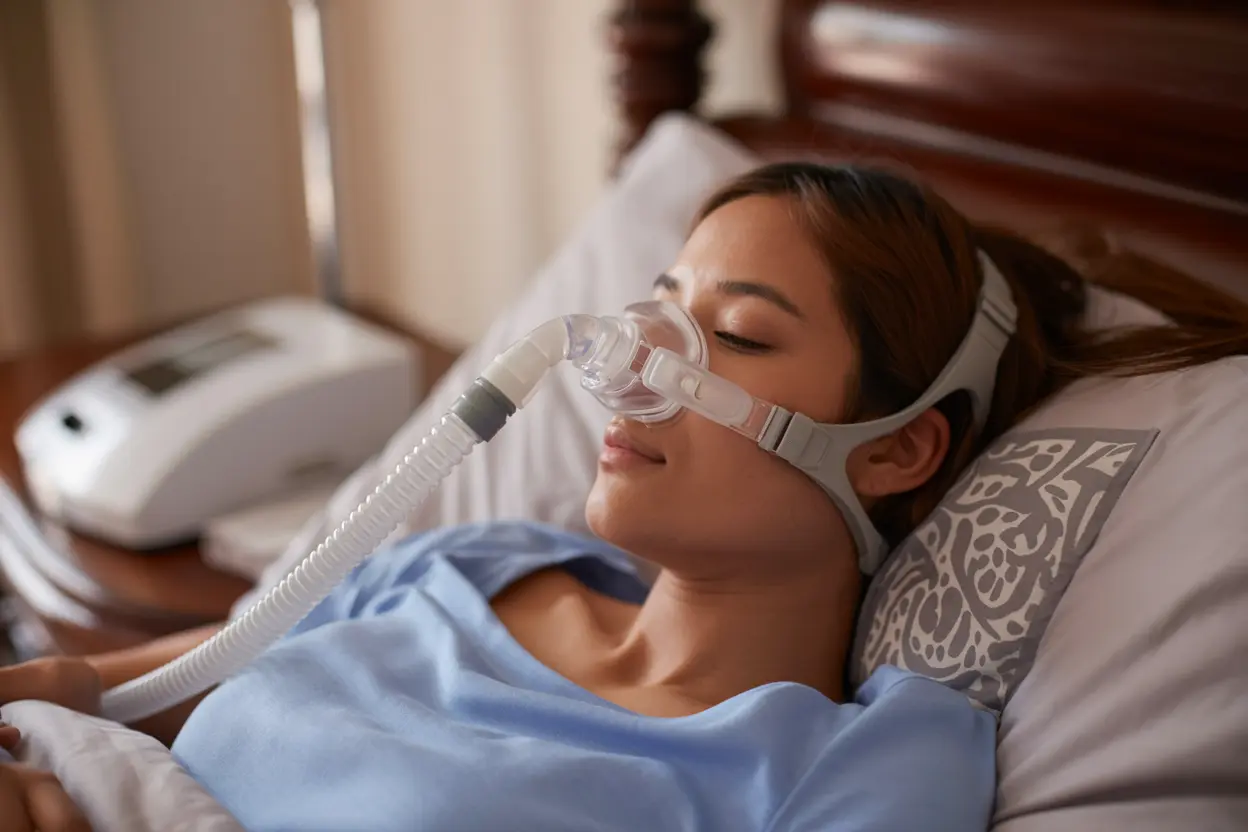
Continuous Positive Airway Pressure, or CPAP, is the standard treatment for moderate to severe obstructive sleep apnea (OSA). CPAP works by delivering steady air pressure through a mask during sleep, helping keep the airway open and preventing repeated breathing pauses.
Research from the European Society of Cardiology suggests that CPAP may provide cardiovascular benefits for certain OSA patients with “high-risk” features, such as significant drops in blood oxygen levels or sharp heart rate increases during apnea episodes. In this group, CPAP use was associated with around a 17% lower risk of major cardiovascular events, including heart attack, stroke, and cardiovascular death. However, the benefit depends on patient risk profile and consistent therapy use, so CPAP should be used under medical guidance.
Long-term studies also show that people with OSA who regularly use CPAP may have a lower risk of death from cardiovascular causes compared with those who do not use the therapy consistently. This highlights why proper diagnosis, treatment adherence, and regular follow-up with a doctor are important for people with sleep apnea and heart-related risk factors.
3. Lifestyle changes
CPAP alone isn't enough. For optimal results, you're advised to adopt a healthy lifestyle, such as:
Lose weight if you are overweight
Avoid smoking
Reduce alcohol consumption, especially before bed
Get enough sleep every night
These lifestyle changes can help reduce the heart's workload, stabilize blood pressure, and improve sleep quality, thereby reducing the negative effects of OSA.
4. Regularly check other heart risk factors
Because OSA often interacts with other cardiovascular risk factors (such as high blood pressure, cholesterol, and blood sugar), it is important for you to have regular check-ups:
Blood pressure
Cholesterol profile
Blood sugar
This way, you can detect and manage risk factors before they develop into serious heart disease. However, beyond the medical aspect, there are other important aspects you need to prepare for financial protection if the risk of a heart attack actually occurs.
Financial Protection Through Heart Attack Coverage
Managing medical conditions like Obstructive Sleep Apnea (OSA) is crucial for maintaining your health. However, it's equally important to have financial protection in place should serious complications arise like a heart attack, which has been clinically proven to be one of the long-term effects of untreated OSA.
According to data from Journal of the American Heart Association, OSA increases cardiovascular risk, including heart attack, even in individuals at a young age. This means that this risk can arise without any obvious initial symptoms and at any time. In such situations, the costs of treatment, hospitalization, and recovery can be a significant financial burden on both you and your family.
As an illustration:
In Indonesia, according to Hello Sehat, the cost of heart attack treatment or surgery such as stent placement, angioplasty, and heart bypass in private hospitals can range from Rp. 80 million to Rp. 500 million, depending on the complexity of the case and hospital facilities.
According to Health365.sg, The cost for an invasive heart procedure such as angioplasty in Singapore can reachUSD29,000–43,000 or S$40,000–60,000 equivalent.
Disclaimer: Cost estimates are illustrative and may vary depending on the hospital and patient condition.
This is where the role of Oona Heart Attack Insurance has become very relevant. This product provides financial benefits if you are diagnosed with a heart attack, without requiring hospitalization. The coverage can be used flexibly for various needs, such as:
Cost of medical treatment or cardiac intervention procedures
Medication and follow-up therapy
Cardiologist consultation and post-event monitoring
Income replacement if you need a long recovery period
Family living needs during the recovery period
Take preventative measures today. See the full benefits at Oona Heart Attack Insurance
To help you take the right steps, here is a short guide that you can use as a reference:
A Short Checklist for You
Steps
| Information
|
|---|
Perform OSA screening
| If you have symptoms or risk factors
|
Manage a healthy lifestyle
| Weight loss, exercise, enough sleep, avoid smoking/alcohol
|
Heart consultation
| If you already have hypertension, arrhythmia or a family history of heart disease
|
Have critical illness insurance
| Make sure coverage includes heart attacks
|
Disclaimer: The above table is illustrative and is not a substitute for professional medical or financial advice.
So, what's the most sensible step you can take starting now? Here are some practical suggestions.
What You Can Do Now
If you start experiencing symptoms like loud snoring, pausing your breath for several seconds during sleep, or frequently feeling tired in the morning, don't ignore them. These could be early signs of Obstructive Sleep Apnea (OSA), a condition that can significantly increase your risk of heart attack.
The best course of action is to consult a sleep specialist or cardiologist for further evaluation. Early diagnosis through a sleep study (polysomnography) can help reduce the risk of serious complications. Additionally, lifestyle changes such as maintaining a healthy weight, getting enough sleep, and avoiding smoking can also significantly reduce the burden on your heart.
As additional protection, also consider having Oona Heart Attack Insurance. With the right protection, you'll be prepared not only medically but also financially, especially if a heart risk actually occurs in the future.
Ultimately, sleep apnea is a real threat that should not be underestimated, especially when it comes to your heart health.
Conclusion
Sleep disorders like OSA aren't just a matter of comfort or lack of rest. Research and medical data show that OSA is closely linked to an increased risk of heart disease, particularly heart attack. Mechanisms such as decreased oxygen, high blood pressure, and irregular heart rhythms are all interconnected and can compromise your overall health.
With proper preventive measures such as early detection, regular medical management, and financial protection through heart attack insurance from Oona. You can reduce the risks that are invisible but very real. Don't wait until symptoms develop into a more serious condition.
Protect your heart. Start now.