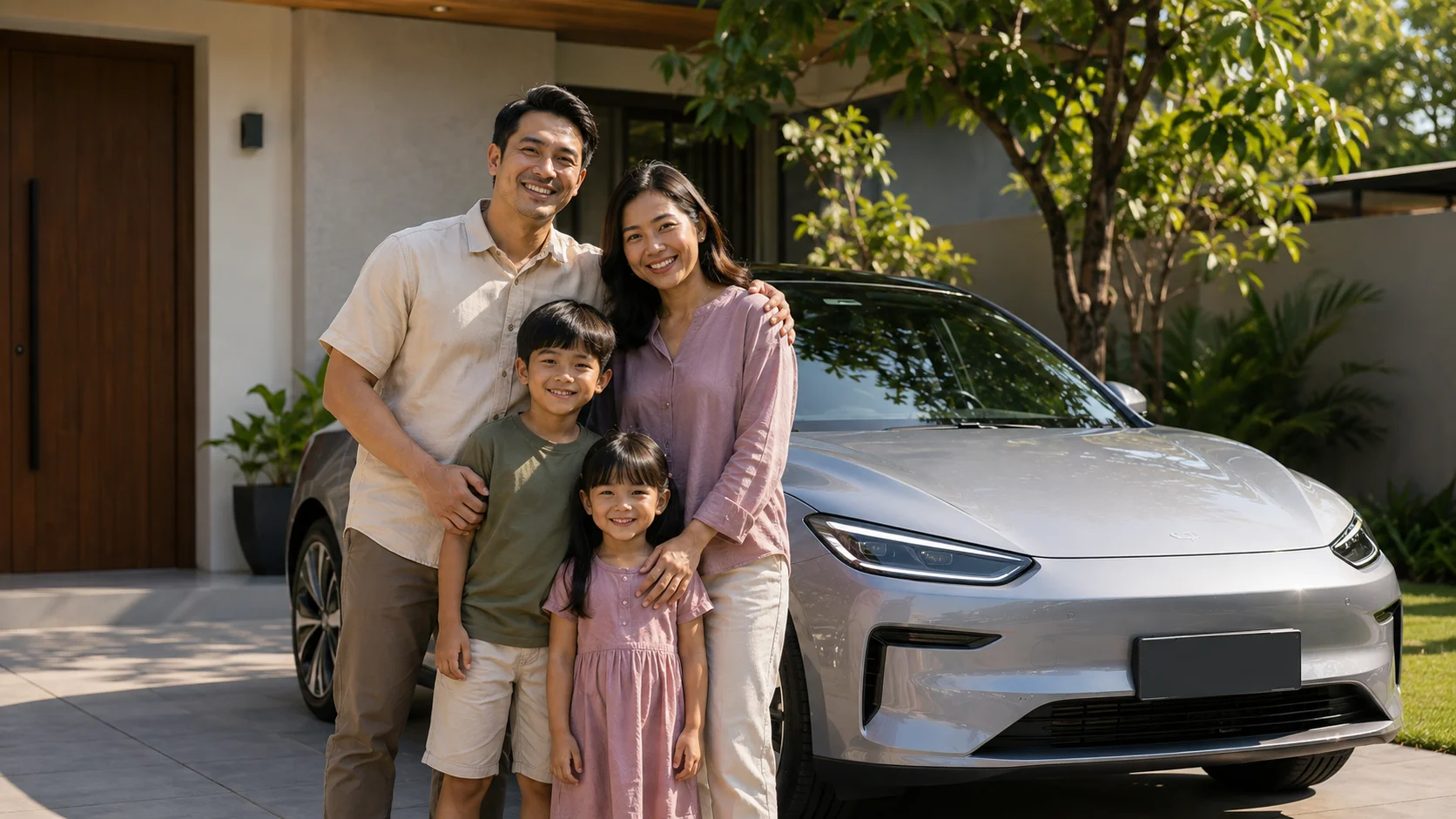
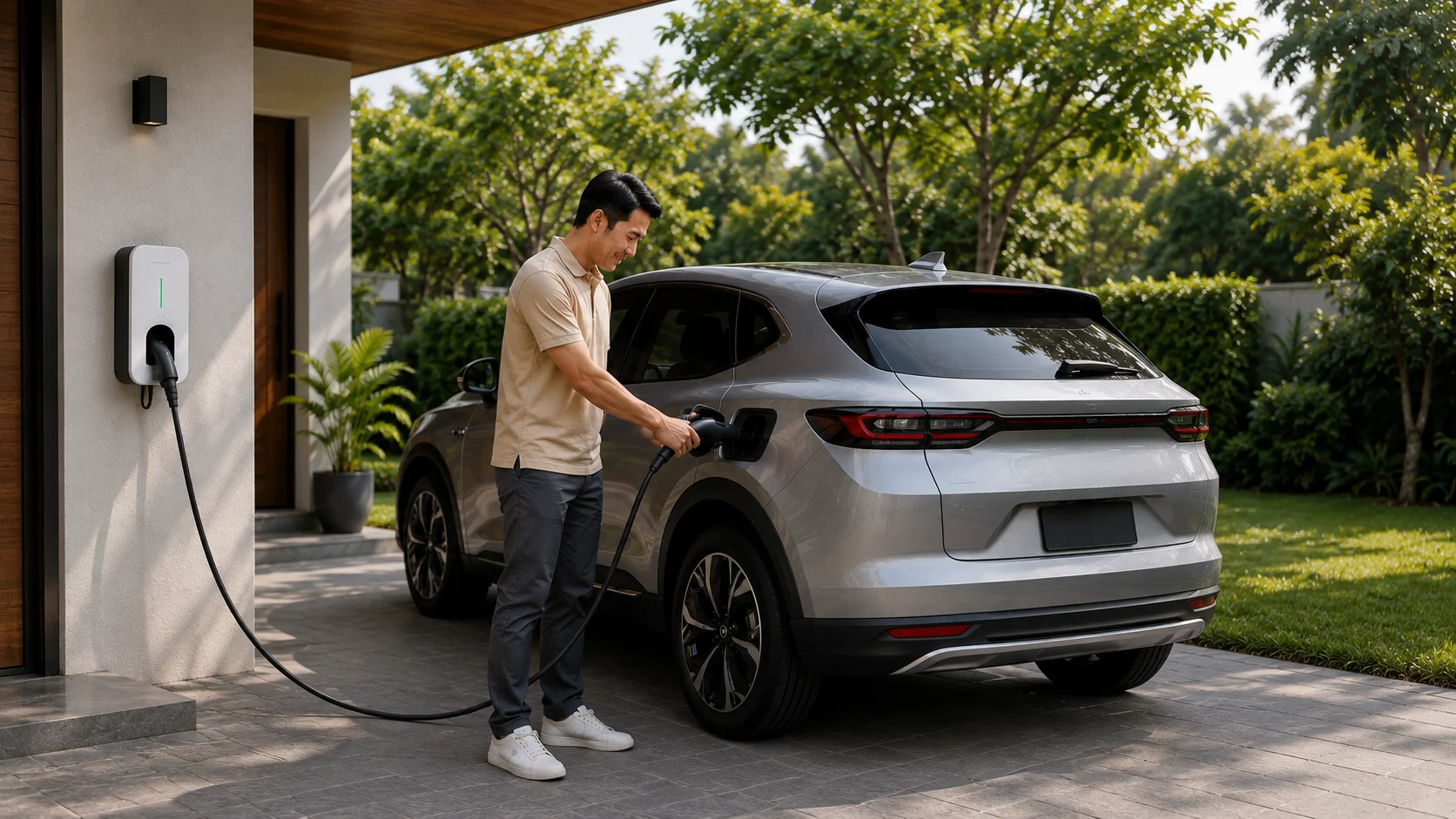
For families, time is an important part of convenience. One advantage of an EV is the ability to charge it while the vehicle is not in use. If the home has a suitable home-charging facility, the car can be charged overnight or while the family is spending time at home.
PLN recorded 70,250 Home Charging Services customers by the end of 2025. This growth shows that home charging is increasingly becoming part of Indonesia’s EV ecosystem. This growth shows that home charging is increasingly becoming part of Indonesia’s EV ecosystem.
Even so, before buying an EV, check the condition of your home electrical installation, power capacity, parking location, compatible charger type, and vehicle-use habits. Not every family has the same charging needs.
3. Family-Friendly Model Options Are Becoming More Diverse
In the past, EV options in Indonesia were limited. Today, consumers can find more models across a variety of brands and segments. There are compact vehicles for couples or small families, crossovers for mixed use, and SUVs and MPVs that are better suited to families needing more space.
This means families do not have to adapt their lifestyle to technology. Instead, the technology can be selected according to the family’s needs. If most driving is within the city, efficiency and ease of parking may be priorities. If you often travel with a larger family, cabin and luggage space may matter more.
In the past, EV options in Indonesia were limited. Today, consumers can find more models across a variety of brands and segments. There are compact vehicles for couples or small families, crossovers and SUVs for more flexible daily use, and electric MPVs that can accommodate families with more passengers.
This means families do not have to adapt their lifestyle to technology. Instead, the vehicle can be selected according to the family’s needs. If most driving is within the city, efficiency and ease of parking may be priorities. If you often travel with a larger family, cabin space, passenger capacity, and luggage space may become more important considerations.
This variety can be seen in the growing range of EV models available in Indonesia. From compact EVs for urban mobility to electric SUVs and MPVs for families, here are several examples:
Brand
|
Example Model
|
Price Range
|
Family Benefits
|
|---|
BYD
|
BYD M6
|
Starting at around IDR 395 million
|
An electric MPV for families with seating for up to 7, suitable for families that need greater passenger capacity and cabin space.
|
Wuling
|
Wuling BinguoEV
|
Around IDR 318–363 million
|
A compact EV for urban mobility, with practical dimensions for daily use and the needs of small families.
|
JAECOO
|
JAECOO J5 EV
|
Starting at around IDR 279.9 million
|
A modern-styled electric SUV offering greater flexibility for everyday family activities and weekend trips.
|
Geely
|
Geely EX5
|
Around IDR 465–505 million
|
An electric SUV with a spacious cabin and smart technology, suitable for families seeking a combination of space, comfort, and modern features.
|
DENZA
|
DENZA D9
|
Around IDR 950 million
|
A premium 7-seater electric MPV focused on comfort and cabin space, especially for larger families or long-distance travel.
|
AION
|
AION V
|
Around IDR 499–560 million
|
An electric SUV with a flexible cabin and storage space, suitable for families that need comfort as well as room to carry more belongings
|
Disclaimer: The model, price range, and feature information above is general and may vary by variant, specifications, and availability in Indonesia. Always check the latest information from each manufacturer before purchasing.
Each model has different characteristics and strengths. Families should therefore consider not only the brand or design, but also the number of seats, luggage capacity, driving range, safety features, access to after-sales service, and charging needs based on everyday usage patterns.
For more options, you can also read Oona’s article on the 5 Best Electric Cars for the Indonesian Market.
4. Quieter, More Comfortable Cabins for Family Trips
The characteristics of electric cars make the driving experience feel different from vehicles with internal combustion engines. Powertrain noise tends to be lower, while electric-motor response can feel quick and smooth. For families, these characteristics can make city trips more comfortable, especially when a child is sleeping or traffic is heavy.
Of course, comfort is not determined by the power source alone. Suspension, tire size, seat design, legroom, cabin cooling systems, and sound insulation should still be checked during a test drive.
5. Technology and Safety Features Are Becoming More Important Considerations
Many new EVs come with a range of driver-assistance and safety technologies. Features such as cameras, parking sensors, blind-spot monitoring, lane keeping assistance, adaptive cruise control, and automatic braking systems are available on certain models, although not all are standard equipment.
For a family car, do not buy simply because the feature list looks long. Check how the features work, whether they are easy to use, and whether they genuinely help in the driving conditions you encounter most often. Fundamental safety elements such as vehicle structure, airbags, brakes, tires, and visibility remain the core foundation.
6. Indonesia’s Charging Infrastructure Is Becoming More Ready
One of the biggest concerns among prospective EV users is a simple question: 'What happens if the battery runs out on the road?' This concern is often called range anxiety. Expanding charging infrastructure helps reduce it.
PLN reported that 4,655 SPKLU units were operating across 3,007 locations throughout 2025. PLN is also continuing to add charger types, including standard, medium, fast, and ultra-fast charging. Differences in charging speed mean users need to understand vehicle and charger compatibility before taking long trips.
Even as the network expands, families still need to develop new habits: knowing where SPKLU stations are located along key routes, estimating driving range, and keeping a reserve charge. For intercity trips, planning charging stops is just as important as planning rest-area stops.
7. Electric Cars Are Becoming Well Suited to Urban Family Routines
Most families do not use their cars for extreme journeys every day, but for recurring routines: commuting to work, taking children to school, shopping, visiting relatives, and weekend activities. These patterns are well suited to the characteristics of EVs.
If daily travel distances are relatively predictable, owners can determine when charging is needed. The car can be charged while parked at home, at the office, at a shopping center, or at other locations that provide charging facilities.
However, an EV is not automatically suitable for everyone. Families that frequently travel long distances to areas with limited charging infrastructure need to consider routes and charging access more carefully.
8. The Road-Trip Experience Is Starting to Change
Long-distance travel by EV is becoming increasingly common. PLN recorded a sharp rise in SPKLU charging activity during holiday periods, including when the number of electric-vehicle users traveling during the 2025/2026 Christmas and New Year holiday period was projected to more than double compared with the previous period.
For families, EV trips can be more comfortable when charging is built into the itinerary. Charging time can be used for meals, rest, restroom breaks, or spending time with children. This way, charging does not always have to be viewed as wasted time.
It is still important to check road conditions, weather, vehicle load, driving speed, and SPKLU availability. The driving range listed in vehicle specifications is a reference point, not a guarantee that the same distance will always be achieved in real-world conditions.
9. EV or Electric Car Prices Are Becoming More Diverse
Price is a major consideration for families. Indonesia’s EV market now offers options ranging from relatively affordable segments to SUVs and premium models. Oona notes that 2026 electric-car prices span a wide range of segments, from entry-level vehicles to premium models priced above IDR 1 billion, depending on the model, variant, location, promotions, and applicable policies.
Because prices can change, families should not compare only on-the-road (OTR) prices. Also consider charger installation costs, electricity consumption, servicing, tires, taxes, battery warranty, resale value, and insurance.
You can read Electric Car Prices in Indonesia 2026 for an overview of prices by segment and the factors that influence them.
10. Battery Technology Is Making Prospective Buyers More Selective
The battery is one of the most important components of an EV. Families therefore need to understand battery capacity, estimated driving range, battery warranty, service-center locations, and the maintenance requirements provided by the manufacturer.
Do not ask only, 'How many kilometers can it travel on one charge?' Also ask how the vehicle performs in real-world use, how long charging takes with different chargers, whether after-sales service is available in your city, and what the warranty policy is if a battery problem occurs.
The clearer this information is before purchase, the less likely a family is to face unexpected costs or usage difficulties after owning the vehicle.
Electric Cars vs. Gasoline Cars for Families
There is no single type of car that is best for every family. The comparison below can help you understand the general characteristics of each option before taking a test drive.
Aspect
|
Electric Car
|
Gasoline Car
|
|---|
Energy
|
Uses electricity; can be charged at home or at an SPKLU
|
Uses gasoline/fuel and the gas-station (SPBU) network
|
Daily Use
|
Suitable for relatively predictable routes
|
Flexible for long routes with access to gas stations
|
Driving Noise
|
Generally quieter
|
Engine noise is more noticeable
|
Maintenance
|
Does not have an internal combustion engine, but still requires periodic maintenance
|
Requires maintenance of the engine, fuel system, and other components
|
Long-Distance Travel
|
Requires charging planning
|
Generally easier to rely on the gas-station network
|
Ownership Costs
|
Need to account for price, charging, servicing, battery, taxes, and insurance
|
Need to account for price, fuel, servicing, taxes, depreciation, and insurance
|
Family Comfort
|
Driving response tends to be smooth and quiet on many models
|
A very wide range of models is available and the technology is already familiar
|
Disclaimer: The comparison above describes the general characteristics of electric and gasoline cars. Costs, performance, maintenance needs, comfort, and the ownership experience may vary depending on the brand, model, vehicle condition, driving patterns, location, and other factors.
After understanding the differences between the two, the next step is to determine whether an electric car truly suits your family’s needs. Before deciding to buy, there are several important factors to consider, from travel patterns to charging readiness.
What Should You Consider Before Buying an Electric Car?
Although EVs are becoming increasingly popular, buying one is still a significant financial decision. Before making a choice, families should use a more comprehensive checklist rather than looking only at price and design.
1. Calculate Your Daily Driving Distance
Track your travel needs for one week. If the car is used for work, school, shopping, and family activities, add up the estimated kilometers driven each day. This figure helps determine the battery capacity and charging requirements you may need.
2. Make Sure Your Home Is Ready for Home Charging
Check your home’s electrical capacity, parking location, cable routing, and the recommended charger. If necessary, consult a qualified technician about installation and follow the vehicle manufacturer’s requirements.
3. Check SPKLU Stations Along Frequently Used Routes
Open an app or service that provides SPKLU location information and check charging points near your home, office, school, and weekend travel routes. Do not look only at the number of locations; also pay attention to charger types and operating hours where available.
4. Compare Battery Warranties
Battery warranties can differ by brand and model. Read the warranty duration, mileage limit, covered conditions, and claim procedure. This is important because the battery is a key vehicle component.
5. Check After-Sales Service
Make sure service centers and technicians are available to support the vehicle model you choose. For families living outside major cities, access to after-sales service can be just as important a consideration as the vehicle price.
6. Do Not Forget Electric Car Insurance
EVs still face various risks on the road, such as collisions, impacts, theft, and flooding. Coverage for these risks may differ depending on the type of protection, benefits, and policy terms. In addition, the battery, as one of the main and high-value components of an electric car, should also be considered when choosing insurance protection.
Oona offers Electric Car Insurance with All Risk (Comprehensive) and TLO protection options. Coverage may also include the EV battery if it is damaged by an insured risk, subject to the benefits and terms of the policy. Additional benefits are also available, such as authorized dealer partner workshops, Third-Party Liability, and personal accident coverage for the driver.
So, Are Electric Cars Safe for Families?
Safety is not determined by the vehicle’s power source alone. Both electric and gasoline cars should be assessed based on safety-test results, active and passive safety features, tire quality, braking systems, body structure, and how the driver uses the vehicle.
For EVs, families also need to understand how to use and maintain the battery and electrical system. Follow the manufacturer’s charging instructions, use suitable equipment, and do not modify the electrical system without proper technical consideration.
Financial protection is also part of peace of mind. If damage or loss occurs, repair costs for modern vehicles can be significant. Therefore, consider a policy that matches the value of the vehicle and the risks associated with how you use it.
When Is an Electric Car Right for Your Family?
Electric cars tend to be attractive for families that have access to charging at home or at routine locations, use the car mainly for predictable daily travel, and are willing to plan charging for long-distance trips.
On the other hand, if you often make spontaneous trips to areas with limited charging infrastructure, do not have a fixed parking space, or need a vehicle that can replenish energy very quickly wherever you are, a gasoline or hybrid car may still feel more practical.
There is no single answer for every family. The best choice is the vehicle that most closely matches your lifestyle, budget, charging access, passenger needs, and the routes you actually use.
Checklist Before Buying an Electric Family Car
What to Check
|
Questions for the Family
|
|---|
Daily Distance
|
How many kilometers do you travel on average each day?
|
Home Charging
|
Does your home have suitable electrical capacity and parking space?
|
SPKLU
|
Where are the charging points along routine routes and long-distance trips?
|
Capacity
|
Are the cabin and luggage space sufficient for all family members?
|
Battery
|
What are the warranty, capacity, and maintenance terms?
|
Service
|
Is there an authorized service center that is easy to reach?
|
Budget
|
What is the total cost of ownership, not just the OTR price?
|
Insurance
|
Does the protection cover EV-relevant risks, including battery damage caused by an insured risk?
|
Test Drive
|
Does the car feel comfortable for the driver and passengers?
|
Disclaimer: The checklist above is a general guide. Every family’s needs may differ depending on the vehicle model, usage patterns, charging access, budget, and applicable warranty and insurance terms.
Once you have confirmed that an EV suits your family’s needs and circumstances, do not forget to consider vehicle protection as part of the cost of ownership. Insurance can help manage financial risks that may arise while the car is in use.
Consider Electric Car Insurance for More Comprehensive Protection
Choosing an EV for your family means choosing a vehicle that will be used repeatedly for important activities. Vehicle protection should therefore be included in your calculations from the beginning.
Oona Electric Car Insurance offers customizable protection options, including All Risk (Comprehensive) coverage for partial damage through to loss, subject to policy terms, as well as TLO coverage for total-loss risks subject to policy conditions. Coverage may also include the EV battery if it is damaged by an insured risk, subject to the benefits and terms of the policy. Optional additional protection is also available, such as authorized dealer partner workshops, Third-Party Liability, and personal accident coverage for the driver.
If you are considering a new EV or already own an electric car, you can check Oona’s best Electric Car Insurance prices for free to learn about the available protection options.
Ready to Switch to an Electric Car for Your Loved Ones?