Code Element
| Meaning
| Explanation
|
|---|
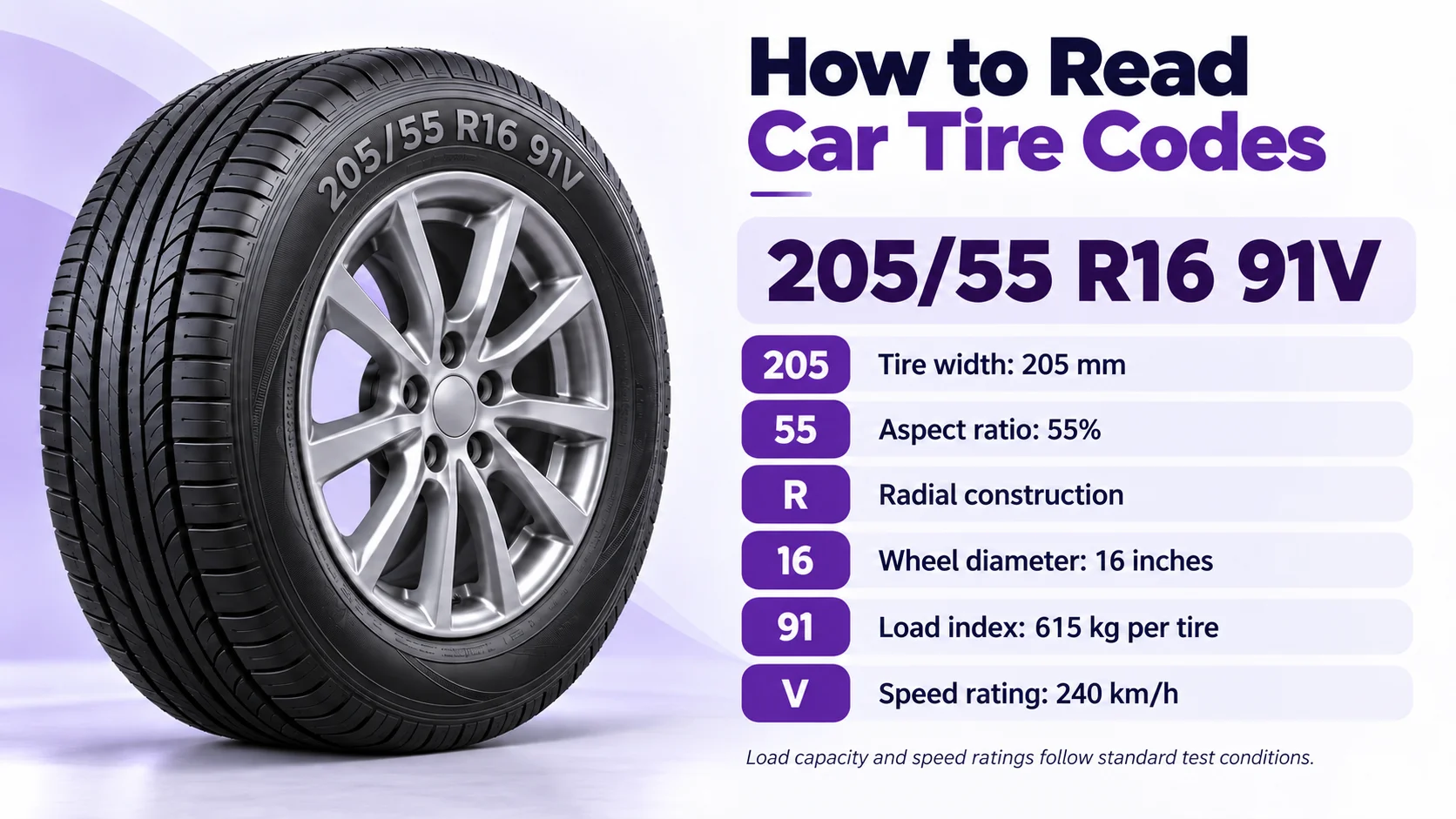
205
| Nominal section width
| 205 millimeters
|
55
| Aspect ratio
| Sidewall height is 55% of the tire’s width
|
R
| Tire construction
| Radial
|
16
| Wheel diameter
| 16 inches
|
91
| Load index
| Maximum capacity of 615 kg per tire under specified conditions
|
V
| Speed rating
| Speed category up to 240 km/h under specified test conditions
|
1. The Number 205: Tire Section Width
The first number indicates the tire’s nominal section width in millimeters. In this example, the width is 205 mm, measured between the two sidewalls. According to Michelin’s tire marking guide, this measurement is the nominal section width, rather than the width of the tread that directly touches the road. Wider tires are not automatically the best choice. Compatibility with the wheel, wheel clearance, and vehicle specifications still needs to be checked.
2. The Number 55: Aspect Ratio
The number after the slash indicates the sidewall height as a percentage of the tire’s section width. For a 205/55 R16 tire, the nominal sidewall height can be calculated as follows: 205 mm × 55% = 112.75 mm. This means that 55 does not indicate a sidewall height of 55 mm. The nominal height is approximately 112.75 mm.
3. The Letter R: Radial Construction
The letter R indicates that the tire uses radial construction. The R in a tire code does not stand for radius.
4. The Number 16: Wheel Diameter
The number 16 indicates that the tire is designed for a wheel with a diameter of 16 inches. It does not indicate the tire’s overall diameter. Tires marked R15 and R16 cannot simply be interchanged because they require different wheel diameters.
5. The Number 91: Load Index
The number 91 is the load index. According to Michelin’s load index table, code 91 corresponds to a maximum capacity of 615 kg per tire under specified conditions.
The number 91 is an index code, rather than a weight in kilograms. A tire’s load capacity does not give you permission to increase the vehicle’s load. Vehicle weight limits and the load limit for each axle must still be observed. When replacing tires, choose a load index that meets the vehicle manufacturer’s recommendations.
6. The Letter V: Speed Rating
The final letter indicates the speed rating, which classifies the tire’s speed capability based on specific tests. Below are some categories from Michelin’s speed rating table:
Rating
| Speed in tire classification
|
|---|
S
| 180 km/h
|
T
| 190 km/h
|
H
| 210 km/h
|
V
| 240 km/h
|
W
| 270 km/h
|
Y
| 300 km/h
|
Disclaimer: A V rating is not a recommendation to drive at 240 km/h. Driving speed must always take account of road speed limits, weather, traffic, and vehicle condition.
Example of Calculating Overall Tire Diameter
Two tires that both fit 16 inch wheels can have different overall diameters because their aspect ratios differ. The estimated nominal diameter can be calculated using this formula:
Overall diameter = wheel diameter in mm + (2 × sidewall height)
Since 1 inch equals 25.4 mm, the nominal diameter of a 205/55 R16 tire is:
(16 × 25.4) + (2 × 112.75) = 631.9 mm
Meanwhile, a 205/60 R16 tire has a nominal sidewall height of:
205 × 60% = 123 mm
Its overall diameter is therefore:
(16 × 25.4) + (2 × 123) = 652.4 mm
Tire Size
| Nominal Sidewall Height
| Nominal Overall Diameter
|
|---|
205/55 R16
| 112.75 mm
| 631.9 mm
|
205/60 R16
| 123 mm
| 652.4 mm
|
Based on this calculation, the difference in diameter between the two sizes is approximately 3.24%. Although the wheel diameter is the same, the overall tire diameter differs. This calculation is a geometric illustration, rather than a measurement of a specific product. Actual dimensions may vary depending on the tire model, wheel, pressure, and load.
A change in diameter can affect the distance traveled with each wheel rotation and the speedometer reading. For this reason, the percentage difference in size alone is not enough to confirm whether a tire is suitable.
What Do Additional Tire Markings Mean?
In addition to the main size code, you may find the following markings.
Marking
| Meaning and Points to Consider
|
|---|
XL or Extra Load
| Higher load capacity than standard tires of the same dimensions. Still check the load index and vehicle specifications.
|
Tubeless
| Designed to be used without an inner tube and requires a compatible wheel.
|
M+S
| Stands for Mud and Snow. This marking alone does not prove that snow performance has met a test standard such as 3PMSF.
|
3PMSF
| The three peak mountain snowflake symbol, associated with tested snow performance.
|
TWI
| Marks the location of tread wear indicators in the tire’s tread grooves.
|
Explanations of tubeless, M+S, and 3PMSF can be found in the guide to reading additional tire markings.
How to Keep Your Tires in Good Condition
1. Check Tire Pressure at Least Once a Month
NHTSA recommends checking tire pressure monthly when the tires are cold, meaning the vehicle has not been driven for at least three hours. This includes the spare tire.
Use the pressure recommended for your vehicle. The maximum pressure shown on the tire’s sidewall is not a guide to everyday inflation pressure for every car.
Front and rear tire pressures may differ. Also check the vehicle’s instructions for a full load and use a pressure gauge instead of relying only on the tire’s appearance.
2. Rotate Tires According to the Guidelines
Michelin provides general guidance to rotate tires approximately every 8,000 to 10,000 km. However, the interval and rotation pattern in the vehicle owner’s manual should remain your reference.
Different front and rear tire sizes may limit rotation options. A rotation schedule is also not a reason to delay an inspection if uneven wear is already visible.
3. Check Wheel Alignment and Balancing
If you notice vibrations or changes in the vehicle’s direction, have it inspected. Wheel alignment and balancing serve different purposes, so the work required should address the cause of the problem.
4. Watch the Load and Check Tires Before Long Journeys
Avoid carrying loads that exceed the vehicle’s capacity. Before a long journey, check tire pressure, tread, sidewalls, and spare tire equipment.
If You Replace Only Two Tires, Where Should They Go?
For vehicles with the same front and rear tire size, Michelin recommends fitting the two new tires, or those with the least wear, on the rear axle. This helps maintain stability, especially on wet roads.
Follow any different recommendations specific to your vehicle. Wherever possible, use tires with the same specifications and model on the same axle.
For AWD or 4WD vehicles, check the manufacturer’s requirements before deciding to replace only some of the tires.
Understand Tire Codes, Choose the Right Tires, and Complete Your Car’s Protection
Complement your vehicle maintenance with Oona Car Insurance to help manage costs arising from risks covered by your policy. Comprehensive coverage offers protection against partial damage, total damage, and theft, while Total Loss Only (TLO) focuses on theft or damage that meets the criteria for a total loss. Choose coverage that suits your needs, taking into account the policy’s benefits, exclusions, and terms and conditions.