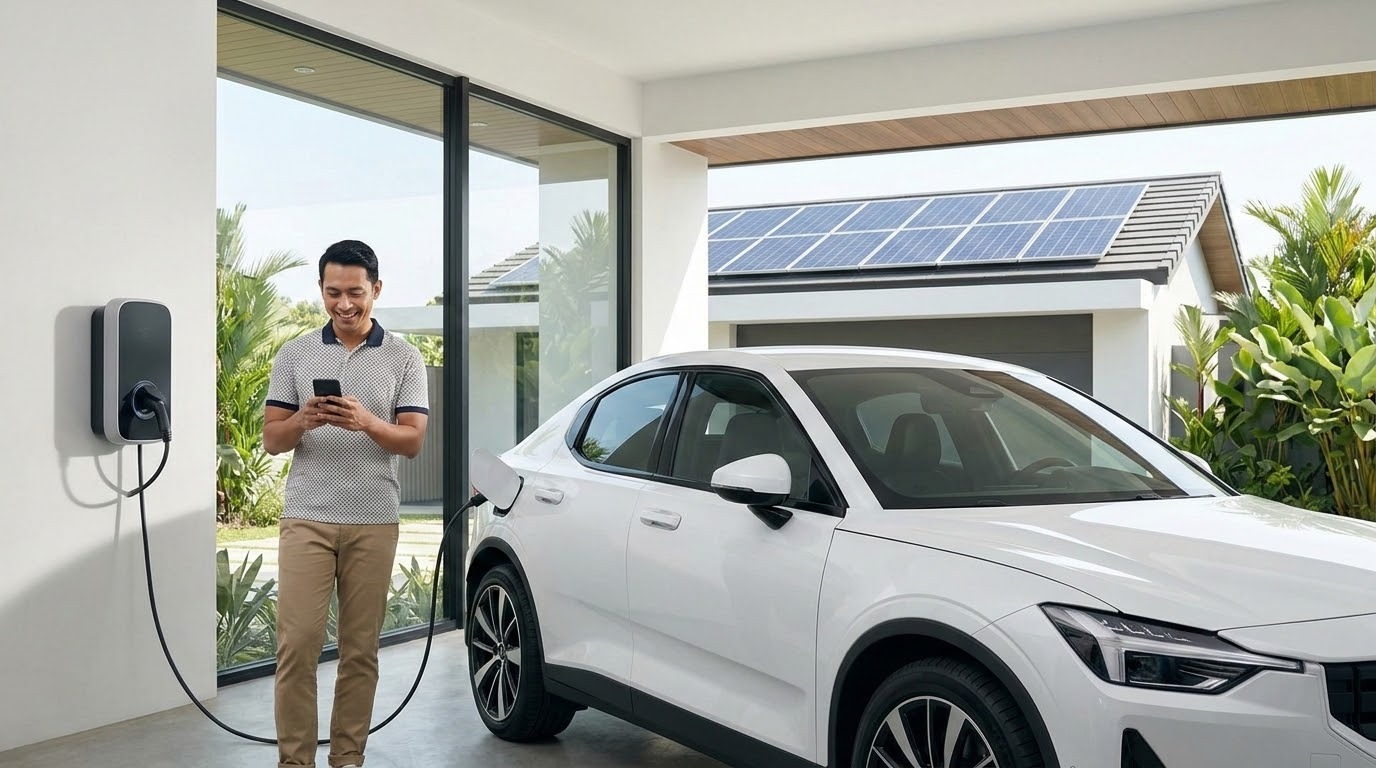
Why EVs Are Becoming More Popular in Indonesia
The adoption of EVs in Indonesia continues to show strong momentum. In 2024, EV sales rose 153% YoY to 43,188 units, around 5% of the total national car market. This trend continued in 2025, with wholesale BEV sales reaching 23.9 thousand units from January to April 2025, up 211% compared to the same period the previous year. Choices are also becoming more diverse, ranging from BYD, Wuling, Chery, Denza, Aion, Geely, Hyundai, MG, Neta, to Citroen, so consumers now have more options according to their needs, driving style, and budget.
Public interest is also reflected in search behavior. Ahrefs data for Indonesia recorded that the keyword “EV” has 63,000 monthly searches, with May 2026 volume in the range of 51,267 searches. This growth is supported by government-borne VAT incentives for certain EVs through Minister of Finance Regulation No. 12 of 2025, with a minimum local content requirement of 40% for certain models. On the other hand, manufacturing investments such as BYD’s planned US$1 billion factory, the government’s target to produce 600,000 EVs domestically by 2030, and the development of charging infrastructure, including 3,772 PLN public EV charging stations as of March 2025, strengthen the belief that EVs are no longer just a trend, but part of the new direction of Indonesia’s automotive industry.
With more EV choices in the market, prospective buyers need to look beyond just brand or price. Each vehicle category has different functions and advantages, so the best choice should be adjusted to daily usage needs.
5 EV Categories in Indonesia 2026
Choosing an EV should not be based only on price or brand, but on daily usage patterns, required driving range, access to charging facilities, ownership costs, and vehicle protection after purchase.
Therefore, the following grouping is arranged based on the needs of Indonesian consumers, from daily commuters in major cities to families who often travel between cities.
Category
|
Suitable For
|
Main Advantages
|
General Estimated Driving Range
|
|---|
Electric City Car
|
Daily city commuters, first-time EV buyers, users with short routes
|
Compact size, easy to park, more efficient daily usage costs
|
200 to 280 km
|
Electric Compact SUV
|
Young families with 1 to 2 children
|
More spacious cabin, more comfortable ground clearance, more complete safety features
|
300 to 400 km
|
Mid-Size or Large SUV
|
Large families, out-of-town trips, homecoming trips, or weekend use
|
Larger capacity, longer range, more flexible luggage space
|
400 to 600 km
|
Electric Sedan
|
Professionals, executives, and business users
|
More elegant appearance, smooth performance, premium driving experience
|
350 to 500 km
|
Entry-Level or Locally Produced EV
|
First-time EV buyers who prioritize price
|
More affordable price, low daily costs, suitable for urban mobility
|
150 to 250 km
|
Disclaimer: The driving range estimates above refer to general ranges often found in manufacturer specifications, such as WLTP, NEDC, or CLTC, depending on the model and the vehicle’s country of origin. Actual results may vary due to traffic conditions, temperature, air conditioning use, passenger load, tire pressure, driving style, and battery age.
After understanding the main categories of EVs, the next step is to look at the models available in the market. The following list summarizes several options that can be considered based on user needs, from compact city cars to premium EVs for a more complete driving experience.
Top 10 Best EVs in Indonesia 2026
Here are 10 EV recommendations to consider in Indonesia. This list is not arranged as an absolute ranking, but based on usage suitability, vehicle category, relative price, brand network, and different consumer needs.
Brand and Model
|
Category
|
Suitable For
|
Why It Is Worth Considering
|
|---|
Wuling Air EV
|
Electric City Car
|
City users, first-time EV buyers, family second car
|
Its size is compact, easy to park, and suitable for short-distance daily trips in major cities.
|
BYD Atto 1
|
Entry-Level EV
|
First-time EV buyers looking for a more affordable price
|
Attractive for consumers who want to enter the EV ecosystem at a more affordable price.
|
Wuling BinguoEV
|
Electric Hatchback
|
Daily commuters who want a more comfortable cabin than a small city car
|
Its design is more stylish, still practical for the city, and suitable for users who want a daily EV with a modern look.
|
BYD Dolphin
|
Electric Hatchback
|
Young users, small families, and first-time EV owners
|
Offers a practical hatchback format, a functional cabin, and BYD’s reputation in the EV segment.
|
MG 4 EV
|
Electric Hatchback
|
Users looking for a more dynamic driving experience
|
Suitable for buyers who want a sporty-style EV with a more enjoyable driving character.
|
Chery Omoda E5
|
Electric Compact SUV
|
Young families who want an EV SUV with complete features
|
Offers a modern SUV design, comfortable cabin, and attractive features for daily and weekend use.
|
BYD Atto 3
|
Electric Compact SUV
|
Small families and users who want a versatile EV SUV
|
One of the relevant electric SUV choices for users who need a more spacious cabin and higher seating position.
|
AION Y Plus
|
Electric Crossover
|
Families who need a roomy cabin
|
Suitable for users who prioritize cabin space, passenger comfort, and a longer driving range.
|
BYD M6
|
Electric MPV
|
Families with children, MPV users, and medium-distance trips
|
Attractive because it offers an electric MPV format that better suits the needs of Indonesian families.
|
Hyundai IONIQ 5
|
Premium EV
|
Professionals, executives, and users who want a premium local EV
|
Offers futuristic design, mature EV technology, a premium driving experience, and status as one of the EVs produced in Indonesia.
|
Disclaimer: This recommendation list is editorial in nature and does not represent an official ranking, endorsement, or form of commercial cooperation with any particular brand. Prices, specifications, features, warranties, promotions, and unit availability may change at any time depending on variant, city, dealer, and purchase period. Always check the latest information from the official brand website or dealer before buying.
The recommendation list above can help narrow down the choices, but the final decision still needs to be adjusted to your routine. An EV suitable for daily commuting is not necessarily ideal for a large family, and vice versa.
How to Choose an EV That Suits Your Needs
After looking at the recommendation list, the next step is to match the choice with your driving habits. The ideal EV for one person is not necessarily suitable for another.
1. For daily city use
If your route is mostly just home, office, children’s school, mall, and activities around the city, an electric city car or hatchback is sufficient. Models such as Wuling Air ev, BYD Atto 1, Wuling BinguoEV, BYD Dolphin, or MG 4 EV can be initial options.
The main focus for this category is vehicle size, ease of parking, efficiency, and ownership costs.
2. For young families
If you have a spouse, children, a stroller, car seat, and more frequent luggage needs, an electric compact SUV or crossover can be more comfortable. Chery Omoda E5, BYD Atto 3, and AION Y Plus can be considered for these needs.
The main focus for this category is cabin space, safety, rear-seat comfort, luggage space, and charging access for weekend trips.
3. For large families
If you need 6 to 7 seats, an electric MPV such as the BYD M6 is more relevant than a hatchback or compact SUV. This type of model is more suitable for families with more than one child, trips with parents, or weekend activities with many passengers.
The main focus for this category is seat configuration, second- and third-row comfort, luggage capacity, and driving range when the car is fully loaded.
4. For premium users
If you are looking for a more premium driving experience, the Hyundai IONIQ 5 can be a strong choice. Cars like this are suitable for users who prioritize design, technology, comfort, performance, and vehicle image.
The main focus for this category is safety features, charging technology, cabin comfort, after-sales service, and long-term vehicle value.
After knowing the type of EV that best suits your needs, there are several practical factors that need to be calculated before buying. These factors will affect usage comfort, ownership costs, and the long-term driving experience.
Things to Consider Before Buying an EV
Before choosing a particular model, prospective buyers should evaluate several practical aspects that will affect the daily usage experience. EVs do offer more efficient operating costs, but the benefits will be maximized if the vehicle suits your routine, routes, and charging access.
1. Driving range and daily needs
Calculate your average daily mileage, including trips to the office, children’s school, shopping centers, and weekend activities. Choose a vehicle with a range that provides a comfortable buffer, so you do not need to charge every day.
For example, users with short daily routes may not need the largest battery. However, if you often travel between cities or pass through routes with limited public charging stations, a longer range will provide peace of mind.
2. Access to public charging stations and home charging
Check the availability of public EV charging stations around your home, office, shopping centers, rest areas, and frequently used out-of-town routes. If you live in an apartment or condominium, first make sure whether installing a private charger is permitted by the building management.
For landed-home owners, home charging can make EV use much more practical. You can charge at night and use the car again the next day.
3. Charging time
Pay attention to the vehicle’s charging capability and the types of chargers available. Fast charging can help during long trips, but for daily use, slow charging at home or the office is often enough if your routine is regular.
Also check whether the vehicle supports DC fast charging, how long charging takes from 30% to 80%, and whether compatible chargers are easy to find along your route.
4. Long-term maintenance costs
EVs have fewer moving components than fuel-powered cars, so some routine service costs can be lower. However, battery checks, cooling systems, software, tires, and brakes still need to be carried out according to the official dealer schedule.
Do not forget to factor in tire costs. The generally heavier weight of EVs can make tires work harder, especially if the car is often used on toll roads or carries many passengers.
5. Battery warranty and after-sales service
The battery is one of the most important components in an EV. Check the battery warranty period, mileage limit, claim requirements, battery degradation coverage, and the availability of official workshops capable of handling EV electrical systems.
Choose a brand with a clear service network, especially if you live outside Jakarta or frequently travel out of town.
In addition to technical factors such as battery, driving range, and charging, there is one important aspect that is often only considered after the vehicle has been purchased. In fact, insurance protection should be considered from the beginning because EVs have risk characteristics that differ from fuel-powered cars.
What Is Often Overlooked When Buying an EV
When choosing an EV, many buyers focus on price, design, driving range, cabin features, and charging time. In fact, insurance protection also needs to be checked from the beginning.
EVs have different characteristics from fuel-powered vehicles, especially because they use high-voltage batteries, complex electrical systems, electronic sensors, and components that require special handling.
Before buying a policy, make sure you do not only compare premiums. Also pay attention to protection benefits, exclusions, partner workshop networks, claim processes, and whether the policy clearly explains protection for EV components.
Protection Aspect
|
Why It Matters for EVs
|
|---|
Battery Components
|
The battery is one of the most important and high-value components in an EV. Check whether the policy covers damage caused by accidents, external risks, or certain conditions related to the battery.
|
Flood Risk
|
EV electrical systems require special attention if the vehicle passes through high puddles or is submerged in a flood. Make sure you understand whether flood protection is included in the main policy or as an additional extension.
|
Comprehensive or TLO
|
For new EVs with high vehicle value, comprehensive protection is generally more relevant because it covers both partial damage and total loss, according to policy provisions. TLO usually only applies to severe damage or total loss.
|
Partner Workshops That Handle EVs
|
Not all workshops have the technicians, diagnostic tools, and safety procedures to handle EVs. Choose insurance with a partner workshop network that suits your vehicle’s brand and technology.
|
Digital Claim Process
|
Easy, fast, and transparent claims are important when the main vehicle cannot be used. Digital claim features can help EV owners submit documents, monitor claim status, and receive repair guidance more practically.
|
Disclaimer: This information is general in nature and does not replace policy provisions. Protection coverage may differ depending on policy type, vehicle model, coverage extensions, exclusions, survey results, usage area, and underwriting and claim decisions. Always read the benefits summary and policy wording before buying EV insurance.
Choosing the right insurance helps protect the vehicle from financial risks, but EV owners also still need to maintain the vehicle’s condition through proper usage habits. Consistent maintenance can help maintain performance, comfort, and vehicle value in the long term.
Tips for Maintaining an EV So It Lasts Longer
EV maintenance is not as complicated as fuel-powered vehicles, but it still requires proper usage habits. The way you charge, drive, and maintain supporting components can affect comfort and the vehicle’s long-term service life.
Keep the battery level from being too often in a very low condition. As a general habit, try to recharge before the battery drops too far.
Use official charging stations or chargers recommended by the vehicle manufacturer.
Follow the official service schedule, especially for checks on the battery, cooling system, software, brakes, and tires.
Pay attention to tire condition regularly because the heavier weight of EVs can affect wear levels.
Avoid driving through floods or high puddles, especially if you do not know the water depth and road conditions.
Keep service documents, charging history, and maintenance records because this information can help during insurance claims or when the vehicle is resold.
By choosing a suitable model and maintaining the vehicle regularly, EV owners can enjoy a more comfortable driving experience. However, risks such as accidents, theft, flooding, or unexpected damage still need to be anticipated through the right insurance protection.
Why Choose Oona Car Insurance for Your EV
Buying an EV is a major decision. In addition to choosing a suitable model, you also need to ensure the vehicle is protected from risks that can occur on the road, in parking areas, or during the rainy season.
Oona offers comprehensive EV insurance designed to provide peace of mind, from accident and theft risks to damage caused by flooding. The application and claim process is carried out fully digitally, with a broad partner workshop network and responsive customer service support.
Before bringing home your dream EV, take time to check protection options on the Oona EV Insurance page.
In the end, buying an EV is not just about following the trend of future vehicles. This decision needs to be viewed as a long-term investment that involves vehicle choice, ownership costs, maintenance, and suitable protection.
Choose an EV According to Your Needs and Protect It with the Right Insurance
EVs are increasingly becoming a realistic choice for daily needs in Indonesia, whether for city commuters, young families, MPV users, or drivers looking for a premium driving experience. With choices such as Wuling Air EV, BYD Atto 1, Wuling BinguoEV, BYD Dolphin, MG 4 EV, Chery Omoda E5, BYD Atto 3, AION Y Plus, BYD M6, and Hyundai IONIQ 5, consumers now have more options according to budget and needs.
However, the decision to buy an EV still needs to be calculated thoroughly. Pay attention to driving range, charging access, maintenance costs, battery warranty, workshop network, and insurance protection. By choosing the right vehicle and EV insurance, you can enjoy the benefits of an EV with greater peace of mind in the long term.