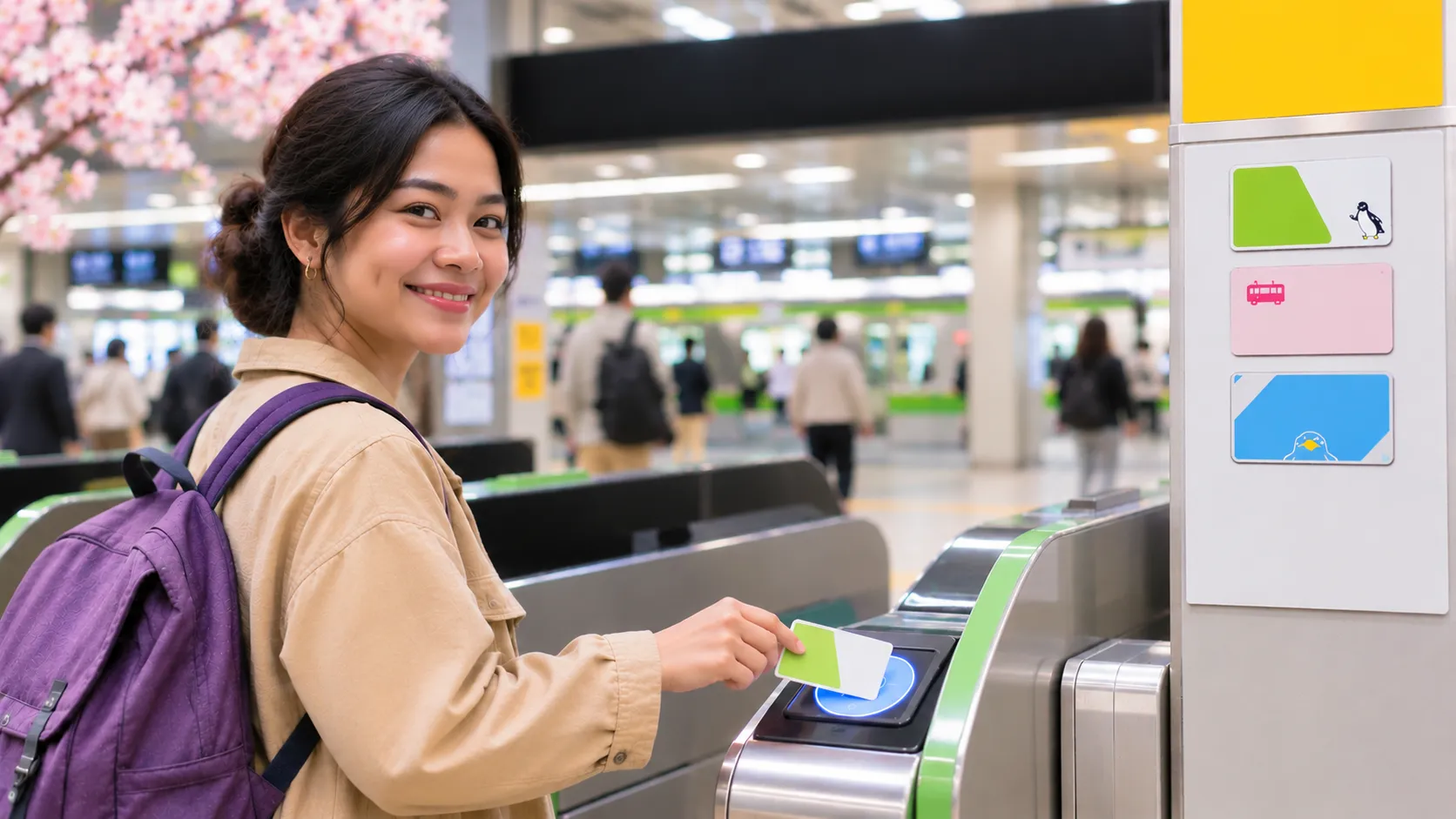
Understanding Japan IC Cards for Transportation and Payments
Japan has an extensive public transportation network, from JR trains and subways to buses connecting popular tourist areas. For Indonesian travelers visiting Japan for the first time, understanding how to pay for transportation is an important part of planning a convenient trip.
One widely used payment method is the Japan IC card, a prepaid card that lets passengers pay fares simply by tapping it on a card reader. According to the Japan National Tourism Organization (JNTO), IC cards such as Suica, PASMO, and ICOCA can be used across various transportation networks that support the system. Beyond trains and buses, they can also be used at convenience stores, vending machines, and participating shops.
Although their functions are similar, Suica, PASMO, and ICOCA are issued by different operators. Understanding these differences can help you choose the Japan IC card that best suits your itinerary.
What Is a Japan IC Card and What Can It Do?
A Japan IC card is a prepaid electronic card that stores value for transportation fares and certain purchases. It eliminates the need to buy individual tickets each time you use a compatible train or bus.
The main uses of a Japan IC card include:
Paying for public transportation: Use it on trains, subways, and buses within networks that accept IC cards.
Shopping at convenience stores: Pay at stores that accept Suica, PASMO, ICOCA, or other compatible IC cards.
Buying food and drinks: Many vending machines accept IC card payments.
Paying at certain facilities: Some station lockers, restaurants, and shops also accept IC cards.
However, an IC card is not an unlimited travel pass. Each transaction deducts the applicable fare or purchase amount from your balance.
Differences Between Suica, PASMO, and ICOCA in Japan
Suica, PASMO, and ICOCA serve nearly identical purposes. Their main differences are the issuing company, their original service area, and administrative services such as purchasing and refunding cards.
IC Card
| Issuer
| Original Region
| Main Uses
|
|---|
Suica
| JR East
| Tokyo and Eastern Japan
| Trains, buses, and payments at merchants accepting IC cards
|
PASMO
| PASMO member transport operators
| Tokyo and Kanto region
| Subways, private railways, buses, and merchant payments
|
ICOCA
| JR West
| Osaka, Kyoto, and Western Japan
| Trains, buses, and payments at merchants accepting IC cards
|
All three cards can be used in many parts of Japan thanks to interoperability between transit IC card systems. For example, travelers who buy a Suica in Tokyo can generally use it in Osaka or Kyoto, provided the transportation service accepts compatible IC cards.
1. Suica: An IC Card for Tokyo and Eastern Japan
Suica is a transit card issued by JR East and widely used in Tokyo and Eastern Japan.
Suica is a practical choice for travelers arriving in Tokyo via Narita or Haneda Airport who plan to use trains and other public transportation.
A regular Suica generally requires a 500-yen deposit, which may be refunded according to JR East procedures and conditions.
2. PASMO: An IC Card for Subways and Transportation in Kanto
PASMO is issued through a network of transportation operators in the Kanto region, including private railways, subways, and buses.
Although issued by different operators, Suica and PASMO can generally be used interchangeably across compatible transportation networks.
This means travelers do not need to buy both cards simply to use JR trains and Tokyo Metro during the same trip.
3. ICOCA: An IC Card for Osaka, Kyoto, and Western Japan
ICOCA is issued by JR West and widely used in the Kansai region, including Osaka and Kyoto. It is a practical choice for travelers arriving at Kansai International Airport and exploring destinations across Western Japan.
Like Suica and PASMO, ICOCA can also be used on many transportation networks outside its original service area that accept compatible IC cards.
Tourist IC Cards: Welcome Suica and TOURIST PASMO
In addition to regular cards, Japan offers IC card options designed specifically for international visitors.
Card Type
| Deposit
| Validity
| Refund of Remaining Balance
|
|---|
Regular Suica
| 500 yen
| No short fixed validity; may expire after 10 years of nonuse
| Available subject to rules and administrative fees
|
Physical Welcome Suica
| None
| 28 days
| Generally unavailable
|
TOURIST PASMO
| None
| 28 days
| Unavailable
|
Welcome Suica is a tourist card issued by JR East. It is valid for 28 days from purchase and does not require a deposit. Remaining balances generally cannot be refunded, so it is best to load only what you expect to use.
TOURIST PASMO is an IC card for international visitors introduced in May 2026. It is available at selected locations at Haneda and Narita airports, with purchase amounts varying by location. It is valid for 28 days, and remaining balances are nonrefundable.
Digital options such as Welcome Suica Mobile are also available on compatible devices. Note that Welcome Suica Mobile has different terms from the physical Welcome Suica card, including a balance validity period of up to 180 days from issuance.
Where to Buy a Japan IC Card
Japan IC cards can be purchased at various locations depending on the card type and your arrival destination.
At train stations: Look for ticket machines or counters selling Suica, PASMO, or ICOCA.
At airports: Some airports offer IC card sales, including tourist-specific cards.
On mobile devices: Use a digital IC card service if your phone and payment method are supported.
For regular cards, the purchase price usually includes an initial balance and a deposit. Tourist cards such as Welcome Suica and TOURIST PASMO do not require a deposit. Check the operator’s official website for current sales locations and availability, as these may change.
How to Use a Japan IC Card on Trains
Once you have a card with sufficient balance, using it is straightforward.
Tap your card at the entrance gate: Make sure the reader recognizes it and the gate opens.
Board the train to your destination: Check the route and transfer stations to avoid traveling in the wrong direction.
Tap your card again when exiting: The fare will be calculated and deducted from your balance.
Check your remaining balance: Your balance is usually shown on the ticket gate display.
If your balance is insufficient or the gate does not open, use a fare adjustment machine or ask station staff for assistance.
Keep in mind that an IC card does not automatically cover every train service. Shinkansen journeys, certain limited express trains, and travel across separate IC card service areas may require additional tickets or payments.
How to Top Up a Japan IC Card
Suica, PASMO, and ICOCA can be recharged at machines that support the relevant cards.
Here are the general steps for topping up a Japan IC card:
Find a ticket machine or IC card charging machine at a station.
Select the Charge or Top Up option.
Insert or tap your card as instructed by the machine.
Choose the amount you want to add.
Complete the payment and wait for confirmation.
For physical cards, cash in Japanese yen is the most common payment method. Not all machines accept international credit cards for recharging.
As a starting point, travelers may load around 2,000–3,000 yen for everyday use and top up as needed. This is not a fixed fare; actual spending depends on your routes and how frequently you travel.
Suica, PASMO, or ICOCA: Which Should You Choose?
The best Japan IC card depends on where you arrive and how long you plan to stay.
Travel Plan
| Practical Choice
|
|---|
First visit to Tokyo
| Suica or PASMO
|
Short trip via Tokyo
| Welcome Suica or TOURIST PASMO
|
First visit to Osaka and Kyoto
| ICOCA
|
Tokyo, Osaka, and Kyoto in one trip
| Any compatible IC card
|
Prefer using your phone
| A digital IC card on a compatible device
|
In short, most travelers do not need to buy Suica, PASMO, and ICOCA together. One compatible IC card is sufficient for many transportation and payment needs throughout the trip.
However, always check whether your chosen service accepts IC cards, especially when visiting smaller towns or taking certain intercity trains.
Tips for Using Japan IC Cards More Conveniently
Keep these tips in mind for a smoother journey:
Check your balance before traveling: Make sure you have enough credit, especially if you plan to take several trains in one day.
Avoid loading too much money: For tourist cards with nonrefundable balances, top up gradually.
Carry some cash: Not all transportation services and shops accept IC cards.
Check train ticket requirements: A standard IC card does not always replace Shinkansen or limited express train tickets.
Keep your card safe: Replacement rules for lost cards vary by card type and registration status.
Besides understanding public transportation, first-time visitors to Japan should also learn about the dos and don’ts in Japan for first-time travelers to better understand etiquette when riding trains, queuing, and spending time in public places.
Complete Your Japan Trip with Oona Travel Insurance
Using a Japan IC card can make getting between destinations more convenient. However, beyond planning transportation, travelers should also consider Travel Insurance before departure.
Unexpected events can occur during a trip to Japan, from flight delays and lost baggage to emergency medical needs. Such situations can disrupt your itinerary and lead to additional expenses.
To help manage these risks, Oona Travel Insurance offers international travel protection options with benefits that may include:
Emergency medical treatment: Helps cover medical expenses resulting from illness or accidents during your trip, subject to policy terms.
Travel disruptions: Provides benefits for certain covered delays or cancellations that meet the policy conditions.
Baggage issues: Helps manage losses caused by lost or delayed baggage, subject to the benefits stated in the policy.
Emergency assistance: Provides access to assistance services according to the selected Travel Insurance plan.
By choosing Oona Travel Insurance that suits your needs, you can prepare more confidently for your trip to Japan. Review the benefits, coverage limits, and exclusions before purchasing Travel Insurance. Enjoy exploring Japan with convenient transportation arrangements and suitable travel protection from Oona.