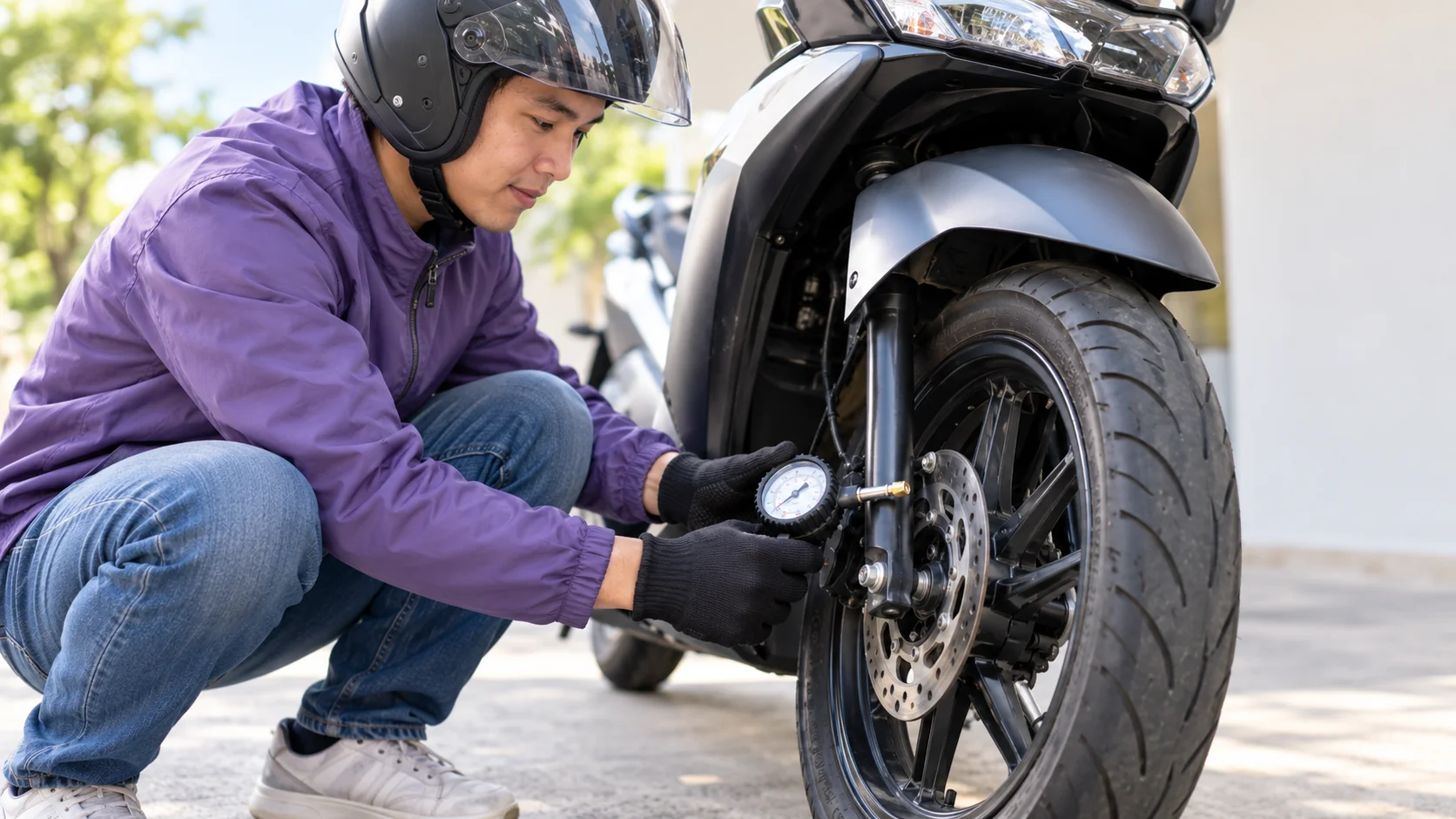
What Is Tire Pressure?
Tire pressure refers to the air pressure inside a tire that helps it maintain its shape, support the weight of the motorcycle, and perform properly while riding. It is commonly measured in PSI (pounds per square inch) or kPa (kilopascals).
Correct tire pressure does not mean inflating a tire to the maximum pressure printed on its sidewall. Instead, use the pressure recommended by the motorcycle manufacturer for the front and rear tires. This information is usually available in the owner’s manual or on a label attached to the motorcycle, such as near the swingarm, frame, or under the seat. The NHTSA also emphasizes following the vehicle manufacturer’s recommended pressure rather than the maximum figure printed on the tire.
Recommended pressures may differ between front and rear tires because they carry different loads and perform different functions. Pressure may also need adjustment when carrying a passenger or additional luggage. The NHTSA advises riders to adjust tire pressure and suspension appropriately when carrying extra weight.
What Is the Ideal Motorcycle Tire Pressure?
There is no single tire pressure suitable for every motorcycle. As a general illustration, many everyday motorcycles use approximately 25 to 33 PSI, but this is only a broad range, not a universal standard. Always follow the manufacturer’s recommendation, since each motorcycle has different weight, tire dimensions, load distribution, and handling characteristics.
Front and rear tires may have different recommended pressures. Rear tires often require higher pressure because they carry more weight, especially with a passenger or luggage. However, do not increase pressure arbitrarily. Follow the manufacturer’s recommended figures for your riding conditions.
Check tire pressure regularly because air pressure can gradually decrease over time. Changes in ambient temperature also affect pressure inside the tire. For more consistent readings, check the tires when they are cold, such as before riding or after the motorcycle has been parked for several hours.
To find the correct pressure, consult the owner’s manual or the tire pressure label on your motorcycle. If you have installed replacement tires with different dimensions or specifications, do not automatically use the pressure shown on the tire itself. Make sure the selected pressure is appropriate for both the motorcycle and the tires.
Riding Condition
|
What to Consider
|
Recommended Action
|
|---|
Daily Riding
|
Pressure should match the manufacturer’s recommendations to maintain handling, comfort, and tire performance.
|
Check pressure regularly, especially before long journeys.
|
Carrying a Passenger
|
The motorcycle carries more weight, particularly at the rear, so the required pressure may differ from solo riding.
|
Follow the manufacturer’s recommendations for carrying a passenger.
|
Carrying Luggage
|
Extra weight and its distribution can affect motorcycle balance and handling.
|
Stay within the motorcycle’s load capacity and use the recommended tire pressure.
|
Long Journeys
|
Tires operate for longer periods, so temperature and pressure may rise during the journey.
|
Check pressure while the tires are cold before departure.
|
After Tire Repairs
|
Removing, refitting, or repairing a tire may change its pressure.
|
Measure pressure again with an accurate gauge before riding.
|
After Long Periods Without Use
|
Pressure can gradually decrease even when the motorcycle is not used.
|
Check pressure before riding again.
|
Weather or Temperature Changes
|
Temperature changes can affect the air pressure inside tires.
|
Check pressure regularly and adjust it according to the manufacturer’s recommendations.
|
Disclaimer: The range of 25 to 33 PSI is only a general illustration and is not a standard for every motorcycle. Do not use the maximum pressure printed on the sidewall as your everyday target. Follow the motorcycle manufacturer’s recommendations for both tires, including any adjustments for passengers or extra loads. Measure pressure when the tires are cold for greater accuracy.
Why Can Front and Rear Tire Pressures Be Different?
Front and rear motorcycle tire pressures are not always the same. This difference relates to the distribution of the motorcycle’s weight, the rider’s position, and the load supported by each tire. Manufacturers may therefore specify different pressures to maintain stability, comfort, and performance.
The front tire plays a key role in steering and handles weight transfer during braking. The rear tire supports part of the motorcycle and rider’s weight while transmitting engine power to the road.
On many motorcycles, the recommended rear tire pressure is higher than the front tire pressure, particularly when carrying a passenger or additional luggage. The exact difference depends on the motorcycle’s design and specifications.
For example, some motorcycles have different recommended pressures for solo riding and riding with a passenger. These adjustments help the tires perform correctly under the additional load.
Important points to remember:
- Always follow the motorcycle manufacturer’s tire pressure recommendations.
- Check whether the manufacturer specifies a different pressure when carrying a passenger.
- Do not assume the front and rear tires should have the same pressure without checking the vehicle specifications.
- If you have changed the tire size or type, consult the tire manufacturer or an experienced technician about the appropriate pressure.
Remember that the maximum pressure shown on the tire sidewall is not necessarily the recommended pressure for everyday use. It relates to the tire’s limits under specified conditions, while operating pressure must suit the motorcycle’s specifications.
The Best Time to Check Motorcycle Tire Pressure
The best time to check motorcycle tire pressure is when the tires are cold. This provides a more accurate reading that can be compared with the manufacturer’s recommended cold tire pressure.
A tire is considered cold when the motorcycle has not been ridden for several hours or has not traveled far enough to significantly increase the tire temperature.
While riding, friction and repeated tire flexing generate heat. The resulting temperature increase can temporarily raise the air pressure. As a result, a reading taken after riding may be higher than the pressure measured when the tire is cold.
Check tire pressure in the following situations:
Before riding: Ideally in the morning, before the motorcycle has been used.
Regularly: Preferably every one to two weeks, or according to the manufacturer’s guidance.
Before a long journey: Ensure the pressure is appropriate for the load and number of passengers.
After a puncture: Recheck the pressure after the tire has been patched or repaired.
When handling changes: For example, if the motorcycle feels heavier, less stable, or different from normal.
If you check the pressure while the tires are hot, do not immediately release air simply to match the recommended cold pressure. Allow the tires to cool before adjusting them unless the manufacturer provides specific instructions.
Effects of Motorcycle Tire Pressure That Is Too Low
Underinflated motorcycle tires can affect comfort, stability, and efficiency. Underinflation occurs when tire pressure falls below the recommended level for the motorcycle and its riding conditions.
At low pressure, the tire flexes more as it supports the load. This can generate additional heat and accelerate damage if the condition continues. Here are some potential effects.
1. Heavier Steering and Handling
Low tire pressure can increase rolling resistance. As a result, the motorcycle may feel heavier to control, especially when turning or maneuvering at low speeds.
2. Higher Fuel Consumption
Underinflation can increase rolling resistance, requiring the engine to use more energy to maintain speed. Over time, this can reduce fuel efficiency.
3. Faster Tire Wear
Low pressure can cause uneven load distribution across the tread. Under certain conditions, the tire shoulders may wear faster than the center.
4. Greater Risk of Tire Damage
Excessive flexing of the tire sidewalls can generate additional heat. During prolonged use, particularly at high speeds or with heavy loads, this may increase the risk of structural tire damage.
5. Reduced Stability and Braking Performance
Low pressure can change how the tire responds to steering and braking, potentially reducing stability when cornering or braking suddenly.
If tire pressure continues to fall after reinflation, promptly check for punctures, damaged valves, or problems with the wheel rim.
Effects of Motorcycle Tire Pressure That Is Too High
Overinflated motorcycle tires can also cause problems. Although the tires may feel firmer and the motorcycle may seem lighter to ride, excessive pressure does not necessarily improve performance. Consider the following effects.
1. Reduced Riding Comfort
An excessively firm tire has less ability to absorb uneven road surfaces. Vibrations and impacts may feel stronger when riding over potholes, bumps, or rough pavement.
2. Changes in the Tire Contact Patch
Excessive pressure can change the tread shape and the distribution of pressure where the tire meets the road. Under some conditions, this can reduce the tire’s ability to maintain optimal grip.
3. Uneven Tire Wear
Excessive pressure may place more load on the center of the tread. Depending on the tire and riding conditions, the center may wear faster than the shoulders.
4. Changes in Motorcycle Handling
Pressure above the recommended level can change the motorcycle’s handling characteristics, particularly when cornering or riding on uneven roads.
For these reasons, inflating tires above the manufacturer’s recommendation is not an appropriate way to improve fuel efficiency or make the motorcycle feel lighter.
Signs of Incorrect Motorcycle Tire Pressure
Incorrect tire pressure is not always visible. A tire may look normal even when its pressure is too low or too high. However, certain changes can indicate that it is time to check the tires.
What You Notice
|
Possible Cause
|
What to Do
|
|---|
The motorcycle feels harder to steer
|
Tire pressure may be too low, or another vehicle component may have a problem.
|
Measure cold tire pressure and inspect the wheels.
|
The handlebars feel unstable
|
Incorrect pressure, tire wear, or suspension or steering issues.
|
Check both tires and related components.
|
Uneven tire wear
|
Incorrect pressure, wheel balance issues, or suspension problems.
|
Inspect the wear pattern and have the motorcycle checked at a workshop.
|
Tire pressure frequently drops
|
A slow puncture, faulty valve, or a leak where the tire meets the rim.
|
Find the source of the leak and arrange repairs.
|
The ride feels excessively harsh on uneven roads
|
Pressure may be too high, or the suspension may be responsible.
|
Compare pressure with the manufacturer’s recommendation.
|
The motorcycle feels unstable when cornering
|
Incorrect pressure or worn tire tread.
|
Check pressure, tread wear, and overall tire condition.
|
Disclaimer: These symptoms are not always caused by tire pressure. Suspension, wheels, steering, and other motorcycle components can also affect comfort and stability. If the symptoms persist after adjusting pressure, have the motorcycle inspected at a workshop.
Important Considerations When Adjusting Motorcycle Tire Pressure
Maintaining tire pressure involves more than simply adding or releasing air. Keep the following points in mind to ensure pressure suits the motorcycle.
1. Do Not Rely Only on How the Motorcycle Feels
An underinflated tire does not always look flat. Likewise, an overinflated tire may still feel normal while riding.
Using a pressure gauge is therefore more reliable than judging tire condition by appearance or riding comfort alone.
2. Do Not Use Maximum Tire Pressure as Your Daily Target
The tire sidewall usually displays information such as tire size, load index, speed rating, and certain pressure limits.
The maximum pressure figure is not automatically the ideal pressure for everyday use. Operating pressure must account for the motorcycle’s design, weight distribution, and manufacturer’s recommendations.
3. Consider Changes in Load
A motorcycle used for solo riding may require different pressure when carrying a passenger or extra luggage. If the manufacturer specifies pressure for carrying a passenger, use that recommendation before setting off.
Avoid carrying loads beyond the motorcycle’s capacity, since correct tire pressure cannot eliminate the risks of overloading.
4. Inspect the Entire Tire
Correct pressure does not guarantee that a tire is in good condition if the tread is worn or the tire is physically damaged.
Check tread depth, sidewall condition, tire age, and other signs of damage. Tires with bulges, serious cracks, or structural damage should be examined by a technician and may need replacement.
5. Use the Correct Pressure Units
Motorcycle tire pressure is commonly measured in PSI (pounds per square inch), kPa (kilopascals), or bar. For reference, 1 bar is approximately 14.5 PSI or 100 kPa. Ensure your pressure gauge uses the same units as the motorcycle manufacturer’s recommendations to avoid inflation errors.
6. Take Care When Using Tires with Different Specifications
Changing the standard tire size, construction, or type can affect motorcycle handling. Make sure replacement tires are compatible with the motorcycle and consult the tire manufacturer or a qualified technician about the appropriate pressure. Do not automatically reuse the same pressure without considering the change in specifications.
Tips for Maintaining Optimal Motorcycle Tire Pressure
Maintaining the recommended tire pressure is a simple form of maintenance that supports riding comfort, efficiency, and safety. Here are some useful habits.
Check pressure regularly. Make it a habit to measure tire pressure every one to two weeks or according to the manufacturer’s instructions.
Measure pressure when tires are cold. This helps provide more consistent readings.
Use a reliable pressure gauge. Do not judge pressure only by appearance or by pressing the tire with your hand.
Follow the motorcycle manufacturer’s recommendations. Do not rely on estimates or pressure figures for another motorcycle.
Adjust for the load. Check whether different recommendations apply when carrying passengers or luggage.
Recheck pressure after tire repairs. Make sure pressure is correct after patching, replacing, or removing a tire from the rim.
Pay attention to handling changes. Unusual vibrations, heavy steering, or reduced stability may indicate a need for inspection.
Inspect valves and rims. Damage to these components can cause slow air leaks.
Do not ride on damaged tires. Correct pressure cannot repair structural damage or severely worn tread.
Check tires before long journeys. Make sure both pressure and tire condition are suitable for the trip.
These habits help riders maintain tire performance and reduce the risk of problems caused by incorrect inflation.
Care for Your Motorcycle Tires and Protect Your Vehicle from Road Risks
Maintaining the recommended motorcycle tire pressure is a simple but important step toward comfortable, stable, and safe riding. Both underinflation and overinflation can affect handling, tire wear, and fuel efficiency.
Because every motorcycle has different specifications, the vehicle manufacturer’s recommendations should be the main reference for front and rear tire pressure. Check pressure regularly when the tires are cold, especially before long journeys or when carrying a passenger.
In addition to maintaining the correct air pressure, remember to inspect the tires and other motorcycle components. Consistent maintenance helps preserve motorcycle performance and reduce the risk of problems on the road.
However, routine maintenance alone cannot prevent every risk on the road. Complement your motorcycle care with Oona Motorcycle Insurance, which helps provide financial protection against risks covered under the policy. With proper maintenance and suitable insurance protection, you can ride with greater peace of mind and confidence.